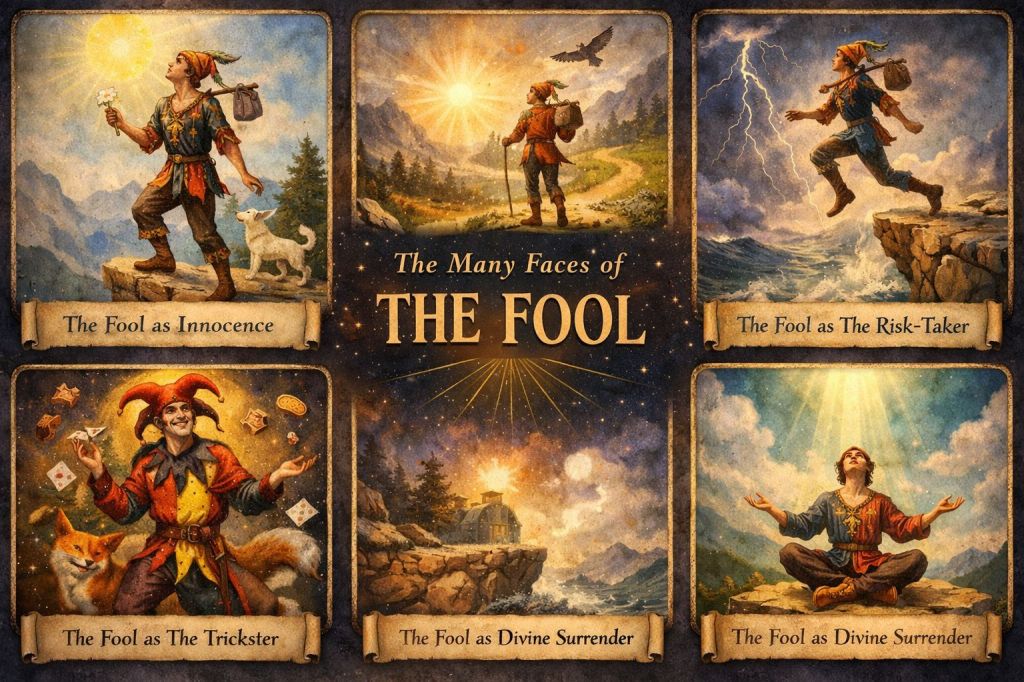
Varying Definitions in Tarot: Few tarot cards invite as much debate, reverence, and personal interpretation as The Fool. Numbered 0 (and sometimes XXII), The Fool stands at the threshold of the Major Arcana. Across traditions, readers, and eras, The Fool has been defined in strikingly different ways: sacred innocent, reckless wanderer, divine spark, cosmic trickster, or the soul itself beginning its journey. This post explores the varying definitions of The Fool, tracing how meaning shifts depending on symbolism, philosophy, spiritual lens, and lived experience.
The Fool as Innocence. One of the most. widely accepted interpretations of this card, not ignorance, but unconditioned openness. In this definition, The Fool represents the part of us that has not yet been shaped by fear, failure, or expectation. Here, The Fool is Curious rather than cautious, Trusting rather than strategic, Present rather than predictive. This Fool does not yet know what is “possible” or “impossible,” which makes everything possible. Many readers see this as the card of pure potential, the blank canvas before the first stroke is made. In readings, this definition often appears when someone is being invited to begin without overthinking. To step forward with faith rather than certainty. The Fool as the Sacred Traveler. In esoteric and spiritual tarot traditions, The Fool is understood as the soul itself, embarking on the journey through the Major Arcana. Each card that follows represents a lesson, initiation, or awakening the soul must experience. From this perspective, The Fool is eternal, The journey is cyclical, and The end always returns to the beginning. This definition reframes The Fool not as naïve, but as divinely guided. The cliff’s edge is not danger it is destiny. The unseen ground below represents trust in a higher order, whether one calls it the universe, God, source, or divine intelligence. In this sense, The Fool is the most spiritually mature card of all, because it willingly surrenders control. The Fool as Risk, Recklessness, and Leap Faith. Not all traditions view The Fool gently. In some readings, The Fool warns of carelessness, impulsivity, or ignoring consequences. This interpretation emphasizes the cliff, not the sky. Here, The Fool can mean: Acting without preparation, Romanticizing risk, Trusting blindly instead of wisely. This definition is especially common in practical or predictive readings, where context matters. The same leap that leads to liberation in one spread may signal avoidable loss in another. This version of The Fool asks an important question:> Is this faith or avoidance disguised as freedom? The Fool as the Divine Trickster. In mythological and archetypal psychology, The Fool aligns closely with the Trickster. A figure found in cultures worldwide. The Trickster disrupts order, breaks rules, and exposes truth through humor, chaos, or paradox. Under this definition, The Fool: Challenges social norms, Reveals hidden truths, Teaches through disruption rather than instruction. This Fool is not foolish at all. Instead, they are wise beyond convention, using absurdity to illuminate what logic cannot. In readings, this version of The Fool often appears when life is about to unfold in unexpected ways. Ways that may feel chaotic at first, but ultimately lead to liberation. The Fool as Trust in the Unseen. For deeply spiritual readers, The Fool represents faith without evidence. The bag over the shoulder holds only what is necessary. The dog (or inner voice) urges awareness, but not fear. The path ahead is unknown and that is the point. This definition emphasizes: Surrender over control, Alignment over planning, Listening over forcing. The Fool appears when the universe is asking someone to move before the proof arrives. The Fool in Reverse: Fragmented Meanings When reversed, The Fool’s definitions often fragment rather than simply invert. Depending on the reader, it may indicate: Fear of beginning, Refusal to trust intuition, Recklessness without awareness, Being stuck at the threshold. In some traditions, a reversed Fool suggests the journey has been delayed not denied. The step will still come, but only when resistance is released. Why The Fool Has No Single Definition. The Fool resists definition because it represents becoming, not being. It is motion, faith, curiosity, and paradox embodied in one figure. To define The Fool too rigidly is to misunderstand its purpose. Ultimately, The Fool means something different to each reader and often something different each time it appears. It may ask: What are you willing to risk? Where are you being invited to trust? What would happen if you didn’t know the outcome? Conclusion: The Wisdom of Not Knowing The Fool reminds us that wisdom does not always come from experience sometimes it comes from the courage to begin anyway. Whether seen as innocent, reckless, divine, or cosmic, The Fool stands at the edge of the known world, smiling not because the path is safe, but because it is true. And perhaps that is The Fool’s greatest teaching:> You do not need certainty to take the next step, only trust. In tarot, as in life, The Fool asks not where you are going—but whether you are willing to go at all. 🌒🌕🌘
 Rantings of an Old Woman 👩🦳🧙♀️
Leave a comment